
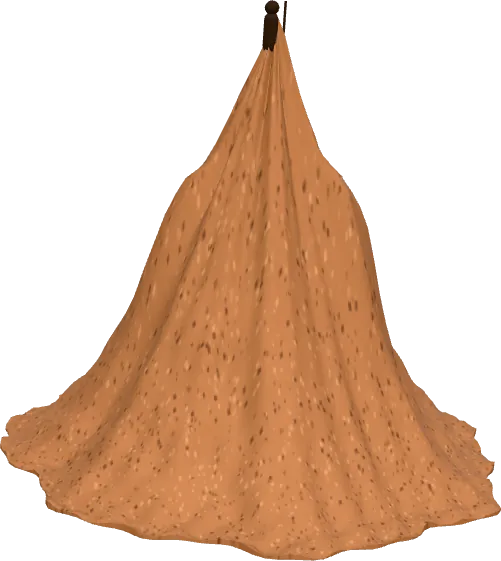
The British banned cowries in 1901. Baganda courts went on taking fines and taxes in shells for at least another decade.
Omusolo
What did you carry?
Before tax was a number it was something you made, caught or dug, and then took to someone. This story follows that load from the oldest tales we can find to the message on your phone.
The page under these words is barkcloth. A peasant in Buganda, John Roscoe was told, paid tax in “a fixed number of barkcloths and one hundred cowry-shells”. You are reading on the money.
An outsider’s written accountRoscoe, The Baganda, 1911, pp. 244 to 245The Cat and the Fowl
Folk taleGanda, as printed in Roscoe, 1911, pp. 470 to 471At one time the fowls used to be lords of the wild cats, and made them their servants and employed them to supply them with food.
Whenever a cat caught flying ants, the fowls demanded four-fifths of all they caught; this tax was paid in large packets of ants, which the cats had to tie up and bring before the fowls to let them see what spoil they had taken.
The cats did not like this arrangement, and once or twice they wished to rebel, but were cowed by the fowls threatening to burn them with their combs.
Four packets go. One stays. This is a story, so four-fifths is not a rate that anyone paid. Roscoe does not say what the packets were made of. We drew a leaf.
One day the cats’ fire had gone out, and a mother cat sent one of the younger members of the family to the fowls to beg for fire. When the young cat arrived, he found the Cock very drunk and fast asleep, and the others away from home; he tried to wake him, but failed to do so; he therefore went back and told his mother.
The mother said: “Go back again with some dry grass and put it to his comb and bring the fire.”
The comb is on the page. It looks hot. Do what the cats did.
After feeling it they finally waked the fowl and told him they were not going to serve him any longer, they were tired of his rule. The fowl was angry and began to make a great noise, and tried to terrify the cats with threats, but they said, “We don’t fear you; we have tested your comb while you were asleep and know that it has no fire in it, and now we will kill you if you say anything more.”
The fowl saw that his empty boasting had been discovered, and from that time fowls have had to escape cats because of the enmity between them; for this reason fowls took refuge with man to be safe from cats.
A second tale, from the north
Folk taleAcholi, “Rwot won ngom”, in Okot, 1963, pp. 63 to 66. Told here in our own wordsBrothers are out hunting, scrambling for wild cattle. The eldest cannot walk well and catches none. So he climbs an ant hill and claims the land instead, and says what anyone who kills on it will owe him:
- The stomach of a bull
- A hind leg of game
- A tusk of any elephant
- A leopard’s skin
- At harvest, tyer
His brothers agree, each gives him cattle, and he becomes rich and a chief. Okot p’Bitek says the myth explains tyer, tribute, and shows chiefship coming from public recognition and not from force.
One rule refused once its threat proves empty. One rule agreed to at the start. These are not two peoples’ fixed characters, and one tale proves nothing about a whole society. Neither tale tells us what anyone paid, or when.
“Tax” in the first tale is Roscoe’s English. He was a British missionary, writing down what he was told under colonial rule. We have not yet found the Luganda telling.
The word
- omusoloLuganda, in the name Omusolo gwa Kabaka
- tyerAcholi, tribute to a chief
- okuhooraRunyankore-Rukiga, to pay tax. One online dictionary, still to be confirmed
- The other languages: no source found yet, and we will not guess
How long is that?
This line is drawn to true scale, from the earliest iron at Urewe to today. Keep scrolling.
Showing 500 BC to 2026
From about 500 BC to 2026 is about 2,500 years. Colonial rule, 1900 to 1962, is 62 of them. The Uganda Revenue Authority, from 1991, is 35. Sources differ on the early dates.
Iron
ArchaeologyUrewe, about 500 BC to AD 650; sources differ; read in extract onlyLong before any king we can name, people here were smelting iron. The page has turned to the earth they dug it from, and the object coming out of the fire is a hoe.
Here is the honest gap: for these centuries there is no evidence of tax at all. Only of things made, moved and eaten. We do not know who, if anyone, was owed a share.
Then the hoe enters the written record as something owed. In Buganda, Roscoe was told, clans paid tribute in their own craft: hunters in ivory, one clan in baskets and fish, smiths in hoes. Small chiefs paid goats and a few hoes.
An outsider’s written accountRoscoe, 1911, about pp. 168 to 170, and p. 245Then earthworks: at Ntusi, and at Bigo, about 1300 to 1500, long ditches cut into this ground. Somebody’s labour dug them. On whose order is disputed, and we have read this only in extract.
Drawn to suggest a long ditch. It is not a plan of Ntusi or Bigo.
ArchaeologyPosnansky and later work, still to be readSalt, and whose hands
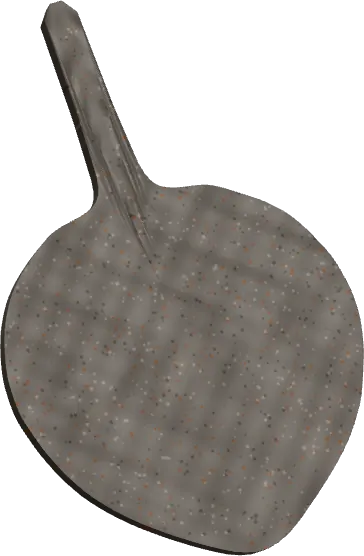
ArchaeologyConnah: Kibiro, “early in the present millennium”; sources differKeep scrolling and the salt comes down. At Kibiro, on the shore of Lake Albert, it is made by women only, to this day.
Kabalega kept underground salt granaries at Kibiro. Bagungu chiefs had women make salt and carry it to them, as tribute.
The law said women generally did not pay. Their hands made what paid it.
Under colonial rule, Kibiro’s women made salt to live on, and to pay the poll and hut taxes imposed on their husbands. No tax table shows this.
A modern historianSsematimba, Kyazike and Khanakwa, 2024, citing Mutebi 2006 and Robertshaw 1997Who owed what
No king does not mean no obligation. Choose a place. We have kept each source’s own terms, and where we have found little, the slip says so. Your choice follows you to the end of the story.
Dots mark rough homelands, not borders. A hollow dot means one thin source, or none yet.
A peasant in Buganda
carried
“A fixed number of barkcloths and one hundred cowry-shells”, and unpaid labour on roads and enclosures.
to
The King, through six collectors, who counted the houses
Women and unmarried men generally did not pay. Pp. 245 to 246 also describe a levy of boys and girls for the royal enclosure.
Roscoe, 1911, pp. 244 to 245; Fjeldstad and Asiimwe, 2025
The caravans
The page is now trade cotton. Traders from the coast reached Buganda about 1843 or 1844, in the reign of Suna.
A modern historianAhmed bin Ibrahim, from press and encyclopaedia extracts; a proper source is still needed“...they introduced firearms and gunpowder in exchange for ivory and slaves.”
An outsider’s written accountRoscoe, 1911, pp. 226 to 227In Acholi, traders from the Sudan arrived in the 1850s seeking ivory and people, and raided from their stations. Soon rwodi began to claim one tusk of every elephant. Wealth became very unequal.
A modern historianAtkinson, 1989. The tale has the tusk among the first chief’s dues: a tale can absorb later practice, which is why it cannot date anythingOn the road there was a toll, hongo. At Usui, now in Tanzania, John Speke recorded what one Arab trader paid its ruler Suwarora. Here it is, at true count:
Some of what was carried was people
Nothing on this page moves.
We do not know most of their names. A count of them is not something we can give you.
| Where | What was written down | Who they were |
|---|---|---|
| Buganda | Traders “introduced firearms and gunpowder in exchange for ivory and slaves”. | Not recorded here |
| Neighbouring states | Paid Buganda in “cattle, slaves, ivory, cowry-shells, salt, hoes”. | Not recorded here |
| Busoga | Its levy was usually paid in slaves, cattle and barkcloth. | Not recorded here |
| The royal enclosure | A levy of boys and girls. | Not recorded here |
| Acholi, 1850s | Traders from the Sudan came for ivory and people, and raided from their stations. | Not recorded here |
| The coast | A charge on each enslaved person exported. Its dates are still to be checked. | Not recorded here |
Roscoe, 1911, pp. 226 to 227 and 244 to 246; 1924, about pp. 98 to 102. Atkinson, 1989. Waris, Kohonen, Ranguma and Mosioma, 2009, printed p. 13. “Not recorded here” means these passages name no one.
One shell for each house
An outsider’s written accountRoscoe, 1911, pp. 244 to 245Back on barkcloth, and there was a count. Roscoe was told how it ran in Buganda: the King, the Katikiro and the Kimbugwe fixed a date, and six collectors went out to each district.
“One cowry-shell was brought by the collector’s assistants to represent each house.”
The King took half. If the count was wrong, the collector went back. It “frequently took two months, or more”, because the barkcloths and hoes had to be made.
A cowry is a sea shell, and Uganda has no sea. It came a long way to be counted here.
A modern historianCowries came in the early 19th century: Pallaver. Fjeldstad and Asiimwe say it is “assumed” Arab traders brought themThe Agreement set a hut tax of “three rupees, or 4s., per annum”, and the same for a gun. People who had paid in things they made now had to find a coin.
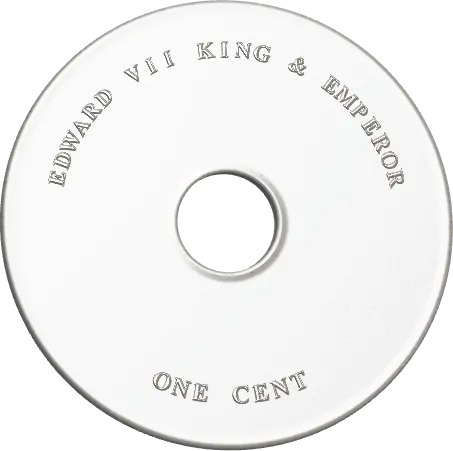
Cents were then minted with a hole, so that “people without pockets” could carry them. The rate: one cent to ten shells.
This is the aluminium one cent of 1907, modelled from its catalogue description: 22.9 mm across. The hole opened out of the shell’s own mouth, and the page went with it.
What three rupees meant in shells
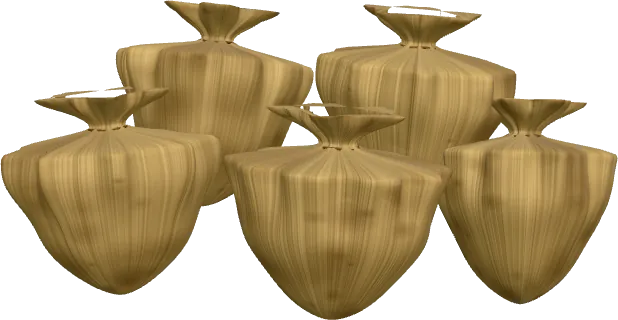
At Pallaver’s rate of a thousand shells to the rupee, the hut tax was 3,000 shells. Roscoe’s peasant paid 100, plus barkcloths. Both heaps are at true count: scroll, and they fill shell by shell.
Our arithmeticThe dates differ and the barkcloth has no value here, so this is a sense of scale and not a rise in tax
Direct taxation, by province
Official recordColonial Reports, Annual: Uganda, 1909-10, printed p. 6In 1909-10 a Poll Tax of five rupees replaced the hut tax of three and the poll tax of two. The Protectorate entered the result in pounds.
| Province, £ | 1905-6 | 1906-7 | 1907-8 | 1908-9 | 1909-10 |
|---|---|---|---|---|---|
| Buganda | 25,662 | 27,878 | 29,322 | 28,905 | 51,491 |
| Eastern Province | 8,995 | 14,198 | 18,301 | 16,516 | 24,985 |
| Western Province | 4,796 | 6,016 | 8,348 | 8,497 | 11,378 |
| Unyoro District | 4,426 | 5,121 | 4,993 | 5,246 | 5,401 |
| Nile District | 1,819 | 1,186 | 993 | 1,207 | 986 |
| Total | 45,698 | 54,399 | 61,957 | 60,371 | 94,241 |
Buganda Eastern Western Unyoro Nile
“extremely satisfactory”
So the Report calls the rise. The same pages mention the famine in Busoga of 1908-9, and sleeping sickness, with people moved and tax remitted.
17days
One man’s tax. Five rupees was 6s. 8d., a third of a pound. At the urban labourer’s wage of 1909, about £0.0199 a day, that is about 17 days of work.
Our arithmeticColonial Report, 1909-10; wage from Albers, Jerven and Suesse, 2023Same move, one border, a year apart
Uganda, 1909-10
Hut tax Poll tax
The reason given: young men were refusing to marry, because a hut holder paid an extra rupee.
Official recordColonial Report, 1909-10Kenya, 1910
Hut tax Poll tax
The official aim, by this account: to push young unmarried men onto settler farms to find paid work.
A modern historianWaris and others, 2009, printed pp. 14 to 15. The ordinance is still to be readSomeone touches the comb
Families crowded into fewer huts at collection time, or moved where enforcement was weaker. In 1907, in Bunyoro, people refused to obey Baganda chiefs or to pay: Nyangire. There was a tax riot there in 1927.
- 1919Non-Africans are taxed at all, for the first time.
- 1925Luwalo, unpaid labour, is commuted to cash.
- 1945Income tax.
- 1954 to 1960The poll tax becomes the Graduated Personal Tax. Enforcement stays coercive: property seized, people punished and shamed.
The ink thins
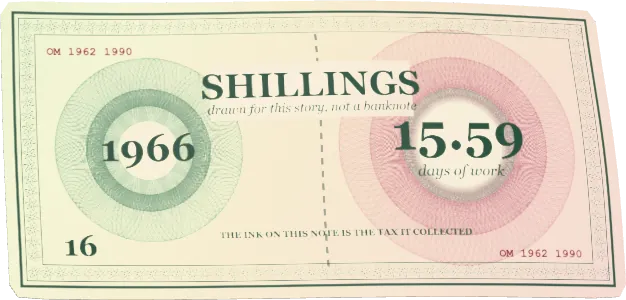
On this page the ink is the tax. The more the state collected, per person, in days of work, the more ink the note carries. Scroll through the years.
1962
10.73 days of work per person
Independence keeps the poll tax. In 1961 it was 91% of what local government collected for itself.
Our arithmetic on Albers, Jerven and Suesse, 2023. Context: Fjeldstad and Asiimwe, 2025, still to be audited.
A hundred and ten years, in days of work
Direct tax Other indirect tax Trade tax
How far this goes: an average over every inhabitant, not what any one person paid. The wage is a yardstick from towns, and it is weakest in the 1970s and 1980s, the years of the collapse. Our arithmetic on Albers, Jerven and Suesse, 2023 (CC0).
Every year as a table
| Year | All tax, days | Direct, days | Trade share of tax |
|---|---|---|---|
| 1906 | 1.13 | 0.90 | 18% |
| 1907 | 1.18 | 1.01 | 15% |
| 1908 | 1.20 | 0.99 | 17% |
| 1909 | 2.10 | 1.52 | 27% |
| 1910 | 2.44 | 1.81 | 25% |
| 1911 | 2.53 | 1.97 | 21% |
| 1912 | 2.80 | 2.16 | 22% |
| 1913 | 3.18 | 2.34 | 26% |
| 1914 | 3.48 | 2.46 | 29% |
| 1915 | 2.78 | 2.14 | 22% |
| 1916 | 2.62 | 1.82 | 30% |
| 1917 | 2.36 | 1.67 | 28% |
| 1918 | 2.20 | 1.54 | 29% |
| 1919 | 2.60 | 1.87 | 25% |
| 1920 | 5.71 | 3.72 | 25% |
| 1921 | 5.68 | 3.48 | 24% |
| 1922 | 4.96 | 2.92 | 30% |
| 1923 | 5.89 | 3.19 | 32% |
| 1924 | 6.05 | 2.60 | 41% |
| 1925 | 5.83 | 2.27 | 42% |
| 1926 | 4.85 | 2.12 | 37% |
| 1927 | 4.55 | 2.65 | 35% |
| 1928 | 5.13 | 2.52 | 35% |
| 1929 | 7.64 | 3.61 | 33% |
| 1930 | 6.93 | 3.73 | 30% |
| 1931 | 6.43 | 4.04 | 33% |
| 1932 | 7.54 | 4.80 | 32% |
| 1933 | 9.54 | 5.72 | 31% |
| 1934 | 13.71 | 7.18 | 34% |
| 1935 | 12.97 | 6.72 | 36% |
| 1936 | 12.03 | 5.90 | 38% |
| 1937 | 12.26 | 5.35 | 44% |
| 1938 | 11.62 | 5.50 | 41% |
| 1939 | 7.28 | 3.76 | 41% |
| 1940 | 7.87 | 3.89 | 41% |
| 1941 | 9.27 | 4.21 | 39% |
| 1942 | 8.98 | 4.86 | 36% |
| 1943 | 10.09 | 4.98 | 45% |
| 1944 | 11.12 | 5.28 | 42% |
| 1945 | 14.47 | 5.13 | 40% |
| 1946 | 15.40 | 4.75 | 47% |
| 1947 | 16.47 | 4.36 | 45% |
| 1948 | 17.90 | 4.24 | 43% |
| 1949 | 22.85 | 3.84 | 80% |
| 1950 | 23.15 | 3.43 | 83% |
| 1951 | 31.27 | 2.84 | 89% |
| 1952 | 27.91 | 3.38 | 86% |
| 1953 | 21.74 | 4.74 | 75% |
| 1954 | 28.27 | 5.75 | 69% |
| 1955 | 21.59 | 5.48 | 62% |
| 1956 | 20.19 | 4.54 | 63% |
| 1957 | 16.10 | 3.85 | 58% |
| 1958 | 15.38 | 3.83 | 61% |
| 1959 | 12.78 | 3.47 | 57% |
| 1960 | 10.73 | 3.06 | 71% |
| 1961 | 9.62 | 2.88 | 69% |
| 1962 | 10.73 | 2.55 | 76% |
| 1963 | 11.79 | 2.26 | 80% |
| 1964 | 14.50 | 2.32 | 84% |
| 1965 | 11.86 | 2.17 | 80% |
| 1966 | 15.59 | 3.21 | 55% |
| 1967 | 12.31 | 2.42 | 56% |
| 1968 | 12.75 | 2.02 | 47% |
| 1969 | 12.48 | 2.27 | 45% |
| 1970 | 13.60 | 2.58 | 45% |
| 1971 | 14.21 | 3.41 | 39% |
| 1972 | 11.04 | 2.04 | 43% |
| 1973 | 10.10 | 1.47 | 44% |
| 1974 | 12.26 | 1.43 | 47% |
| 1975 | 8.73 | 0.94 | 51% |
| 1976 | 11.13 | 1.05 | 52% |
| 1977 | 10.41 | 0.89 | 67% |
| 1978 | 3.13 | 0.40 | 47% |
| 1979 | 2.77 | 0.34 | 46% |
| 1980 | 0.98 | 0.18 | 26% |
| 1981 | 5.00 | 0.48 | 50% |
| 1982 | 7.69 | 0.38 | 68% |
| 1983 | 8.89 | 0.63 | 67% |
| 1984 | 9.47 | 0.58 | 69% |
| 1985 | 6.18 | 0.35 | 75% |
| 1986 | 5.20 | 0.53 | 46% |
| 1987 | 5.42 | 0.48 | 49% |
| 1988 | 4.10 | 0.48 | 33% |
| 1989 | 5.20 | 0.65 | 42% |
| 1990 | 5.68 | 0.70 | 47% |
| 1991 | 5.17 | 0.84 | 48% |
| 1992 | 4.95 | 0.81 | 48% |
| 1993 | 6.16 | 0.98 | 45% |
| 1994 | 7.37 | 1.18 | 42% |
| 1995 | 8.17 | 1.15 | 17% |
| 1996 | 9.00 | 1.34 | 11% |
| 1997 | 9.05 | 1.50 | 10% |
| 1998 | 10.28 | 1.97 | 11% |
| 1999 | 9.99 | 1.96 | 11% |
| 2000 | 10.45 | 2.28 | 14% |
| 2001 | 11.13 | 2.73 | 10% |
| 2002 | 12.43 | 3.24 | 10% |
| 2003 | 12.83 | 3.62 | 9% |
| 2004 | 12.68 | 2.87 | 12% |
| 2005 | 13.51 | 3.27 | 11% |
| 2006 | 14.52 | 3.55 | 12% |
| 2007 | 15.35 | 3.83 | 13% |
| 2008 | 16.42 | 4.04 | 13% |
| 2009 | 16.03 | 4.06 | 13% |
| 2010 | 17.12 | 4.74 | 11% |
| 2011 | 16.75 | 4.72 | 12% |
| 2012 | 18.22 | 5.24 | 12% |
| 2013 | 19.54 | 6.03 | 12% |
| 2014 | 20.36 | 6.16 | 12% |
| 2015 | 22.44 | 6.92 | 12% |
One authority
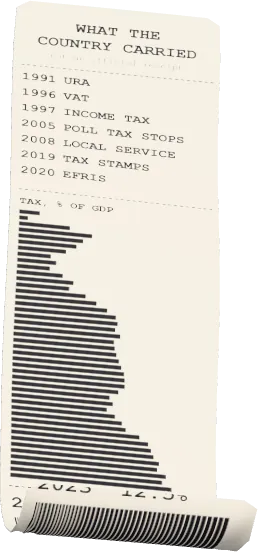
In 1991 the shilling got its own collector. Keep scrolling and the till prints: one line for each year, tax as a share of GDP, with what happened printed where it happened. It is styled like a till roll, and it is not an official document.
WHAT THE COUNTRY CARRIED
not an official receipt
taxes as % of GDP, 1980 to 2023
19801.6
19810.7
19824.0
19835.8
19845.1
19854.6
19863.8
19872.6
19883.1
19892.6
19903.6
19914.5
05 SEP 1991 URA STATUTE COMMENCES
19924.2
19935.5
19946.3
1994 IGANGA RIOTS OVER ASSESSMENT
19957.2
19967.9
JUL 1996 VALUE ADDED TAX
19978.1
1997 NEW INCOME TAX ACT
19987.9
19998.3
20007.8
20017.9
20028.1
20038.3
20048.5
20058.7
2005 POLL TAX STOPS
sources differ: abolished 2005, or suspended and abolished 200820068.8
20078.8
20088.3
2008 LOCAL SERVICE TAX
20097.6
20107.9
20117.4
20128.1
20138.6
20148.9
201510.0
201610.7
201710.9
201811.1
201911.5
01 NOV 2019 DIGITAL TAX STAMPS
202011.3
01 JUL 2020 EFRIS E-INVOICES
202112.0
202211.8
202312.5
19914.48%
202312.46%
each bar is a year. wider means more tax
UNU-WIDER GRD 2025. 1991 and 1992 carry its caution; 1981 looks low and is to be read at source
*** END OF ROLL ***
Who paid
Compliance with the poll tax was never even. Of every hundred men it counted, this many paid:
Fjeldstad and Asiimwe, 2025; Fjeldstad and Therkildsen, 2008. Still to be audited line by line. 1958 is adult men; 1993 is eligible men aged 20 to 59.
Now you are the count
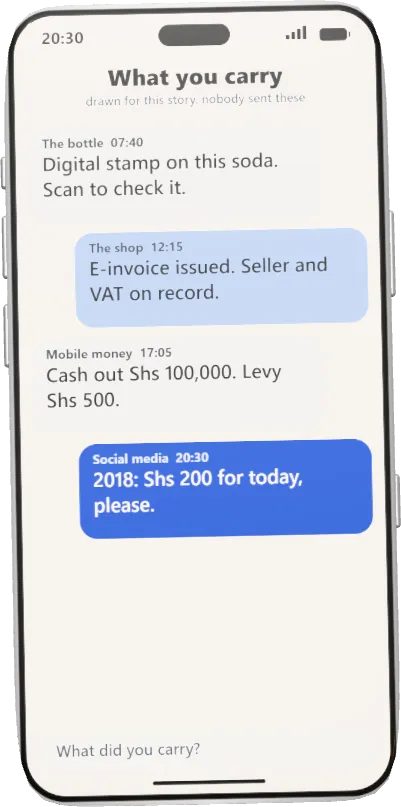
Six collectors once walked a district with a shell for each house. Now the count happens as you buy.
07:40
A soda
Digital tax stamps were rolled out from 1 November 2019: beer, soft drinks, bottled water, wines, spirits and tobacco, and later other goods. URA’s stated aim is tracking and tracing what is made and imported.
Tax Procedures Code, ss. 20 and 21; URA annual report 2022/23
Who stands in between
Then: six collectors, and a chief. Now: the maker and the importer. The tax goes through someone close to you, as it always has.
A shell for each house. An invoice for each sale.
Taxes in 2023: 12.5% of GDP. UNU-WIDER GRD 2025.
07:40. A soda. Digital tax stamps were rolled out from 1 November 2019: beer, soft drinks, bottled water, wines, spirits and tobacco, and later other goods. URA’s stated aim is tracking and tracing what is made and imported. Tax Procedures Code, ss. 20 and 21; URA annual report 2022/23.
12:15. A sale. VAT-registered firms were told to register for EFRIS from 1 July 2020. It was expected to curb invoice mills, repeat claims on one invoice, and under-reported sales. Tax Procedures Code, ss. 92 and 93; WIDER working paper 2025/112.
17:05. Cash out. The levy today is 0.5% of a withdrawal, so Shs 500 on Shs 100,000, with a further 15% excise on the fee. It was first set at 1% on more kinds of transaction. URA’s own report says the rate came down “as a result of the public outcry”. Excise Duty Act, Sch. 2. The Shs 500 is our arithmetic.
20:30. A day online, 2018. From 2018 using social media cost UGX 200 a day, collected through the operators. The charge has since been repealed or replaced. URA blamed the shortfall on Virtual Private Networks, and on people giving up social media. Someone had felt the comb. Excise Duty (Amendment) Act 9 of 2018; URA annual report 2018/19.
Month end. A stall. The poll tax was never fully replaced for local governments. Councils have since multiplied small taxes, licences and fees: more than forty in some. Fjeldstad and Asiimwe, 2025, from our earlier draft, still to be audited.
Plate I
Who this story has data for
The Constitution’s Third Schedule lists 65 communities. We have data for 18 of them, and for several of those it is thin. The numbers are their places in the Schedule.
- 01Acholi
- 03Alur
- 05Baamba
- 09Baganda
- 10Bagisu
- 11Bagungu
- 17Bakiga
- 18Bakonzo
- 21Banyankore
- 26Banyoro
- 30Basoga
- 31Basongora
- 33Batoro
- 36Chope
- 41Iteso
- 50Langi
- 52Lugbara
- 62Sabiny
No data yet for the other 47 communities in the Schedule: Aliba, Aringa, Babukusu, Babwisi, Bafumbira, Bagwe, Bagwere, Bahehe, Bahororo, Bakenyi, Banyabindi, Banyabutumbi, Banyara, Banyaruguru, Banyarwanda, Banyole, Baruli, Barundi, Basamia, Batagwenda, Batuku, Batwa, Dodoth, Ethur, Gimara, Ik (Teuso), Jopadhola, Jie, Jonam, Kakwa, Karimojong, Kebu (Okebu), Kuku, Kumam, Lendu, Madi, Mening, Mvuba, Napore, Ngikutio, Nubi, Nyangia, Pokot, Reli, Shana, So (Tepeth), Vonoma.
No data yet either for those seeking recognition in Parliament: Bagabu, Bakingwe, Baziba, Maragoli, Mosopisyek, Saboat.
No data here means we have not found any. It does not mean they owed nothing.
Constitution of Uganda, Third Schedule, in the 2017 revision on Constitute, checked against the paragraph numbers in the amendment Bills of 2020 and 2022. Neither Bill shows assent on Parliament’s tracker, which may be out of date.
Plate II
Who is owed what, and by whom?
Tax is the price of protection and services, runs one argument, and that is what makes a state legitimate. But where borders were drawn by others, say Attiya Waris and her co-authors, writing of Kenya, that contract may be weak or missing.
The people give
Tax
The state gives
Protection and services
a border, drawn by others
It is still open. In December 2023 the UN General Assembly voted to begin work on a Framework Convention on tax, after Nigeria tabled the draft for the African Group.
Each circle is a vote. Seats are arranged for the count, not where delegations sit.
Plate III
All that was carried
- A hoeIron
- SaltKibiro

- A tuskThe caravans

- A cowryOne for each house

- A holed centThe Agreement
- A shilling noteIndependence
- A receiptOne authority
- A phoneNow
Your load
A peasant in Buganda, and those after you
Before the Protectorate
“A fixed number of barkcloths and one hundred cowry-shells”, and unpaid labour on roads and enclosures.
1909-10, a man’s poll tax
Five rupees
1951, average per person
Almost all of it on trade
1980, average per person
The lowest year of all
2015, average per person
Counted as you buy
Averages are over every inhabitant, in days of an unskilled urban wage. Nobody paid exactly this. The first row is in its source’s own words.
About this story
Each age here has its own material, type and motion, and one load is carried through all of them. This is a first edition, built from what could be read and checked so far. Every label says how far its claim goes, and some still say they are to be audited or were read only in extract.
- Not photographs. The barkcloth, packets, comb, hoe, salt, tusk, cowry, coin, note, receipt, phone and engraving are all made in code. The note and receipt copy no real document. The coin has its legend but not its crown or fine detail.
- Read only in extract. Urewe, Ntusi, Bigo, Ahmed bin Ibrahim, and the Lugbara and Bakiga notes. Pallaver was read in the author’s own summary. Kaggwa, Nyakatura, Karugire, Reid and Connah are still unread, so Ugandan historians are not yet heard as they should be.
- Sources that disagree. Cent coins: Pallaver says from 1905; catalogues date this aluminium cent 1907 to 1908. For GDP share around 1984: the Albers dataset implies 19%, UNU-WIDER gives 5.1%. We rely on days of work for the long line, and on UNU-WIDER for GDP share.
- Sources. Roscoe, 1911. Okot, 1963. Ssematimba and others, 2024. Atkinson, 1989. Speke, 1863. Colonial Report, 1909-10. The Uganda Agreement. Waris and others, 2009. Fjeldstad and Asiimwe, 2025. Albers, Jerven and Suesse. UNU-WIDER GRD, 2025. Constitution of Uganda. Numista.
Plate IV